Updates
52
Species Collected
25
Avian Species
27
Mammalian Species
May 4th, 2026 PLOS Biology Tree Shrew (Tupaia belangeri)

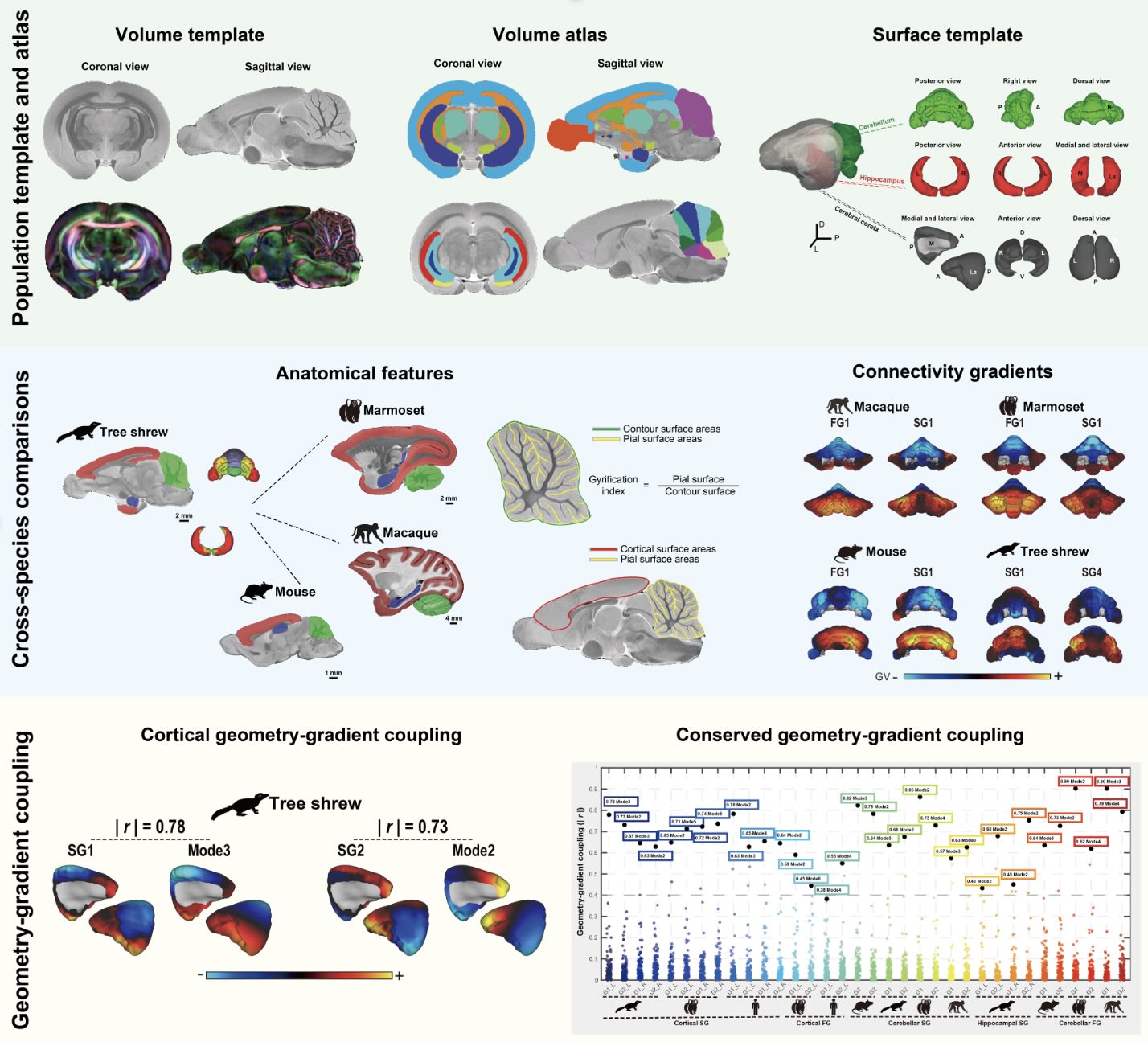
Our new collaborative work with Dr. Yonggang Yao's team, An anatomical and connectivity atlas of the tree shrew brain to bridge rodent and primate neuroanatomy, was recently published in PLOS Biology.

Utilizing 9.4T ultra-high field MRI, we constructed high-resolution MRI atlas of the tree shrew brain. As a crucial phylogenetic bridge between rodents and primates, the tree shrew brain exhibits an "evolutionary mosaic" nature—its cortex shows a transitional morphological state, while its cerebellum highly replicates the primate pattern. Furthermore, we uncovered a universal principle of brain organization—Geometry-Gradient Coupling (GGC)—consistent across five mammalian species.

Congratulations to Xiaojia Zhu!

Tree Shrew Brain Atlas

Figure 1. The ultra-high resolution MRI atlas of the tree shrew brain, revealing its evolutionary mosaic features and the geometry-gradient coupling principle across species.

About Brain Biodiversity

Comparative Brain Mapping For Biodiversity

Bridging the evolutionary gaps in neuroscience

The Brain Biodiversity project aims to explore the immense diversity of brain structures and connectivity across different species. By leveraging advanced ultra-high field MRI and comparative neuroanatomy, our goal is to uncover the fundamental, universal principles of brain organization and trace the evolutionary trajectories of specific neural systems.

A comprehensive understanding of brain evolution requires moving beyond traditional model organisms. By mapping non-model species across diverse taxonomic groups and ecological niches, we can reveal how evolutionary pressures have shaped brain architecture across the animal kingdom.

To achieve this vision, we work closely with biodiversity scientists, zoologists, and conservation teams. These interdisciplinary collaborations provide invaluable access to rare and understudied species, enabling brain mapping research that bridges neuroscience, evolutionary biology, and biodiversity science.